NOVIGENS Talk to usContact us

Industrial AI revolution Machine should reason with “Why” and “What” to do.

CES 2026 · Industrial AI Revolution keynote

Novigens delivers exactly that.

Operational Twin for factory machine.

Complementary to Physical-AI Digital Twin. Reasons with “Why” & “What” from day one.

Capital-efficient. sub-$100K.
Immediate-value. in days.
IP-sensitive. on-edge.
Talk to us

The industrial AI revolution, visualized.

Aspiration: a machine that reasons.

Today
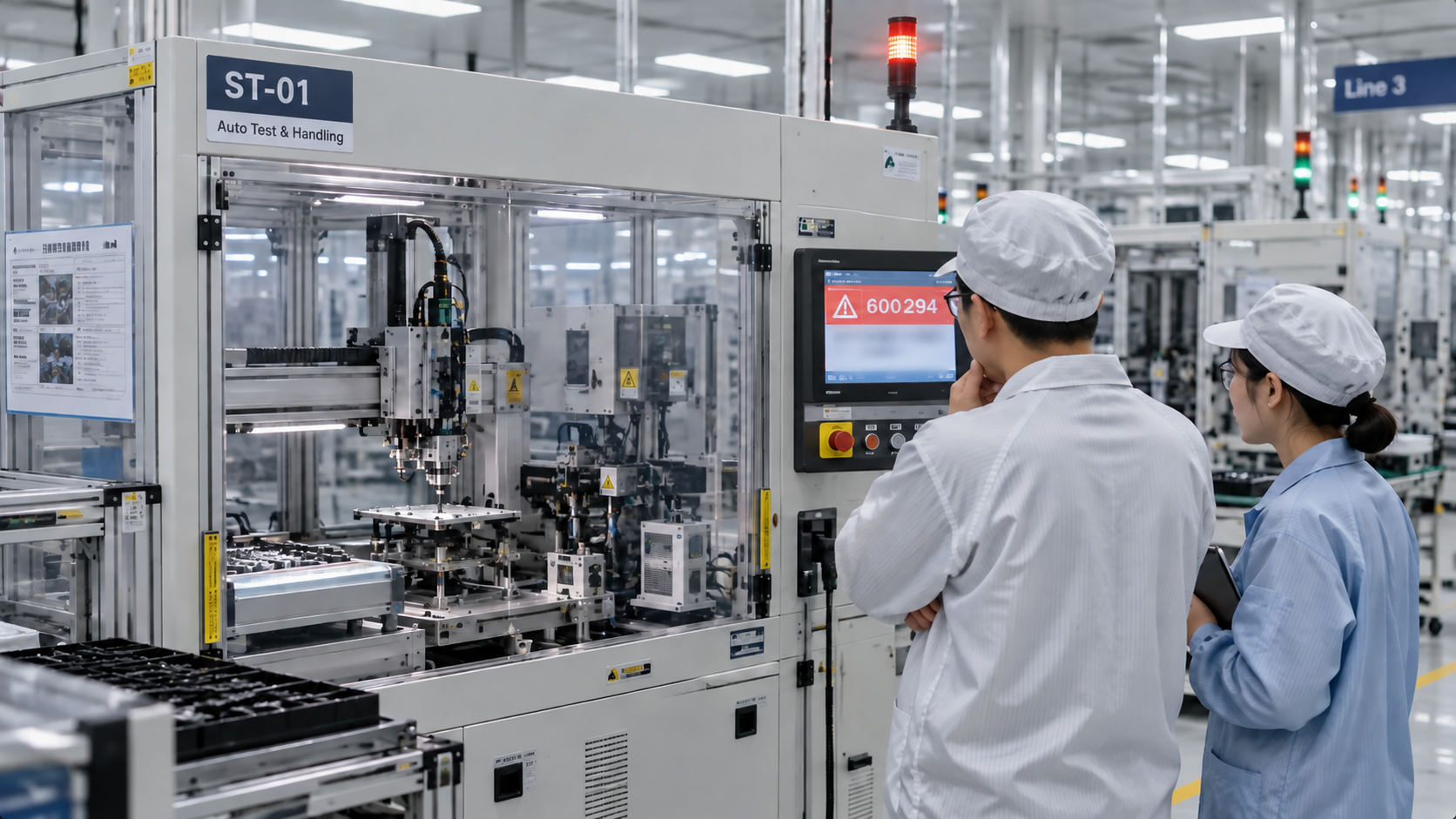
Industrial machine HMI showing a cryptic alarm: Event 47B Pressure Alert at 14:32:08. No explanation. Operator left asking 'Now what?'
Ideally
Same industrial machine, same alarm, now with a Novigens panel attached showing Why (cooling loop lag plus upstream batch change) and What (reduce process X by 12 percent, service sensor 33 within 48 hours). Operator has a clear path forward.
Real, today · Novigens Brain on a factory machine
Screenshot of the Novigens Brain application: a 3D node graph representing the machine's operational reasoning model, with clusters labeled Motion, Alerts, Positioning, Control, Testing, Vision, Relay, Routines, Heartbeat, Safety, History, Material. A critical alarm panel marked NEW for code 600290 (上料真空2, observed 2 times today) shows the Event ('R-Arm1's vacuum 2 did not sense material; observed 2 times today'), the Causes ('1. The vacuum action timed out while waiting for the alarm. 2. The upstream Bin2Tray component is in a rarely-used state and finished homing.'), and the Next Steps (verify the vacuum filter on the upstream vacuum line 2 is clear of any blockages; check the upstream tray feeder to ensure it is not stalled and has sufficient material; inspect the vacuum line 2 for any visible damage or leaks; confirm the vacuum pump is functioning properly and providing adequate suction), with operator actions Confirm / Flag / Skip. A cause-effect popup CE-600290 reads 'check the gating condition or sensor: not waiting for alarm time vacuum action.'

Note: Brain’s output is generated in operator-speak: domain-dense, entity-first, semantically rich. Useful on the factory floor, but can read awkwardly to a general reader. We optimize the panels for the operator under alarm pressure, not the general reader at a desk.

Two Industry AI approaches converging on Why & What

Two paths converging on Why and What, organized as a top-down flow with four nodes — Infra, Data, Modeling, and App and Outcome — that contrasts the Conventional · Physical-AI Digital Twin lane and the Novigens · Operational Twin lane at each node. Infra: Physical-AI Digital Twin needs a 50-billion-dollar GPU-farm AI factory; Operational Twin runs on a less-than-100K-dollar on-edge appliance. Data: Physical-AI Digital Twin needs roughly 100 percent operational data corpus; Operational Twin starts with a cold-start sample of less than 5 to 10 percent. Modeling: Physical-AI Digital Twin builds a Physical-AI Twin over months through gradient training and offers physics fidelity, counterfactual depth, and generative design; Novigens uses One-shot learning to produce its model immediately and offers day-one operator value with engineering IP staying on the floor. Both paths converge on a shared Operational Twin that reasons Why and What. Only the Novigens path has an Active-learning loop where new operational data continuously adapts the Operational Twin. App and Outcome: a Venn diagram shows applications unique to the SOTA path — 3D fab walkthrough, generative recipe and process design, robot policy training, pre-deployment controller validation, counterfactual physics what-if, synthetic training data, geometric and kinematic analysis — shared applications in the intersection — ECO impact, drift detection, anomaly detection, predictive maintenance, decision support, fault diagnosis — and Novigens-only applications — self-explaining dashboard, operation-layout Why and What overlay, debug-triage agent, debug replay and event reconstruction, cold-start operator agents, audit-traceable recommendations, day-one rollout of new equipment. The Shared KPI Impact band lists design and engineering KPIs both paths improve in the same direction — NPI cycle, validation cycle, ECO impact cycle, knowledge retention, service-engineer ramp, field issue to RCA — and operational KPIs both paths improve in the same direction — MTTR, MTBF and uptime, OEE, First Time Right, operator productivity, yield protection. Together strap: SOTA delivers long-arc design-time value with higher investment and longer lead time; Novigens delivers immediate operational value with much lower cost from day one.

Novigens platform Designer + Brain

Platform: Designer one-shot-learns the machine. Brain runs the Operational Twin alongside it with active learning.

The Novigens Platform: Designer (1, Build-time) and Brain (2, Runtime). Designer does One-shot learning from engineering artifacts and compiles the Operational Twin into OT apps or new agentic apps; key capabilities — one-shot learning with no training cycles, compiles agentic apps in hours not 12 to 18 months, auto-models machine from existing engineering artifacts, no ML PhD required. Brain runs Active-learning on off-the-shelf edge compute and runs OT apps alongside the machine, replacing $millions of cloud infra with a sub-$100K edge appliance; key capabilities — active-learning where new operational data adapts the model, runs all OT apps alongside the machine, air-gappable so nothing leaves the perimeter, single appliance installs in days not months.

How Novigens Brain lives in your factory

Integration: Sits next to SCADA and your OT, inside the trusted zone. Your OT apps talk to Brain via API · or use Novigens’ bundled apps. Zero rip-and-replace.

How Novigens Brain lives in your factory: Trusted Factory Zone containing three blocks — Factory Systems with existing OT apps (Preventive Maintenance, Production Dashboard, Line Monitoring, CMMS/EAM, Quality/Yield, and more), Novigens Brain on edge compute (Active Learning and Reasoning forming the Operational Twin loop, plus optional bundled Operational Agentic Apps — Machine Triage, Cause-Effect Explorer, Maintenance KB, Machine Dashboard, and more), and Machine with a smaller inner SCADA/Controller box. Brain exposes API/Query, returns Why/What, and proactively pushes Notify to Factory Systems. Brain observes Telemetry/Log from SCADA and returns Why/What/Action as advisory. MES/ERP bidirectionally orchestrates between Factory Systems and SCADA — not Brain. Action is feasible but not recommended — Brain is advisory by design.

Built for complex machines.

Lane: semicap, electronics assembly, biotech instruments, and advanced industrial OEMs.

If you build advanced machinery

  • Your machine explains itself, next to your SCADA.
  • Your aftermarket lifts.
  • Your IP stays yours.

If you operate advanced machinery

  • Your alarms explain themselves.
  • Your downtime shrinks.
  • Your data stays on-site.

What's real. Today.

Receipts: No vision-ware. The proof we can share publicly.

Team

Built intelligence layers for machinery at Apple. Enterprise Cloud architecture and AI PhD research at the core. Supported by OEMs' CEOs & top AI scientist.

IP

Mechanism filed. One patent allowed. Our partners have freedom-to-operate.

Demos

Working demonstrations under mutual NDA. Live agents on actual machine workflows.

Hardware

Brain runs on off-the-shelf desktop compute. No GPU farm. No cloud dependency.

If the industrial AI revolution resonates,

and you want the “Why” and the “What” to do, on your machine immediately, we’d like to hear from you.

We work with a few advanced OEMs and manufacturers under mutual NDA · and we’d like to work with you.